
'The watershed moment was June 22, 2024, when the divisional in-charge of Gadchiroli, Giridhar Tumreti, who was their senior-most commander, along with his wife, came forward to surrender before the then deputy chief minister and home minister Devendra Fadnavis.'

'For the remaining Maoist cadres, they shall soon confront one of two outcomes: Either surrender or face neutralisation.'
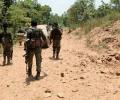
A hill with an altitude of 5,000 feet, once a hub of the Maoists along the Chhattisgarh-Telangana border, was reclaimed by the security forces after driving out the extremists following nine days of intense anti-Naxal operation, official sources said.

Security forces killed 14 Naxalites, including wanted ultras Mangtu (DVCM) and Hunga Madkam, in separate encounters in Chhattisgarh's Sukma and Bijapur districts in the Bastar region on Saturday, officials said.
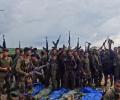
If the threat from the 'Maovadis' (Maoists) is fading, the danger now lies with the 'MoUvadis' -- those who might exploit the resource-rich Abujhmad region through corporate or State-backed projects.
After recent high-intensity operations in the Bastar region and the neutralisation of several senior Maoist leaders, officials say the insurgency has lost its ability to mount large-scale coordinated attacks.

Vimala Chandra Sidam alias Tarakka, a top Naxal leader with a Rs 25 lakh reward on her head, surrendered before Maharashtra Chief Minister Devendra Fadnavis in Gadchiroli along with ten other senior Maoists. Tarakka, who joined the Naxal movement in 1986, rose through the ranks over 38 years to become a Dandkaranya Special Zonal Committee member. She is the wife of Central Committee Member Sonu alias Bhupati. The surrendered Naxals, eight women and three men, were collectively carrying a bounty of Rs 1.03 crore. Fadnavis also felicitated C 60 personnel for the July 17, 2024 encounter wherein 12 hardcore Maoists were killed in a forested area bordering Chhattisgarh.

The Maoists in Bastar went from one village to another with kits providing badly needed medical intervention. The medical help was one key reason why the tribals were attracted to the Maoists, points out M R Narayan Swamy.

Chhattisgarh Chief Minister Vishnu Deo Sai announced that North Bastar and Abujhmad regions are now free of Naxal violence, with the fight against Naxalism in South Bastar reaching a decisive phase. He attributes this success to trust-building measures and the surrender of Naxal cadres.

Inspector general of police, Bastar Range, Sundarraj P said that bodies of seven Maoist cadres have been recovered from the encounter site so far.

'From every point of view, they have faced an extremely difficult couple of years, and the setback they have suffered is irreversible.' 'This reality has begun to set in even amongst the top-level cadres. That is why, in recent times, we have witnessed a huge number of senior-level cadres emerging from the jungle and deciding to renounce violence and join the mainstream.'

139 Naxalite cadres surrendered in Maharashtra and Chhattisgarh, marking a significant turning point in the fight against Left Wing Extremism. The surrenders included a top Maoist strategist and were hailed as a sign of the movement's decline.

Senior Maoist leader Mallojula Venugopal Rao alias Bhupathi surrendered to police in eastern Maharashtra's Gadchiroli district after negotiations. He was a founding member of the People's War Group (PWG) and carried a bounty of Rs 6 crore on his head.
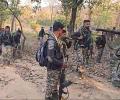
The troops of 209 Commando Battalion for Resolute Action (CoBRA) conducted the operation in which eight Naxals were killed and an AK series rifle, three INSAS rifles, a self-loading rifle (SLR), eight country-made guns and a pistol were seized, the officials said.

Prime Minister Narendra Modi asserted his commitment to eradicating Maoist terror from India, criticizing the previous Congress regime for allegedly supporting 'urban Naxals' and ignoring the violence they perpetrated. He highlighted the significant reduction in Maoist-affected districts and the surrender of numerous Naxalites as evidence of his government's success in combating the issue.

A security camp has been established in the Naxalite-hit Sukma district of Chhattisgarh to improve security and facilitate development. The camp, set up by security forces, aims to dominate the area, secure development works, improve coordination with villagers, and intensify anti-Naxal operations.

Union Home Minister Amit Shah rejects the ceasefire offer from Maoists, stating that surrender is the only option. He also addresses Naxalism's ideological roots and progress in Jammu and Kashmir and the Northeast.

Security forces have established a new camp in the Karregutta Hills along the Chhattisgarh-Telangana border, a former Naxal stronghold, following a major anti-Naxal operation.

Union Home Minister Amit Shah on Friday appealed to Naxals to give up violence, lay down arms and surrender, saying an all-out operation will otherwise be carried out against them.
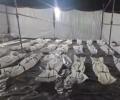
In one of the deadliest blows to Naxalites in Chhattisgarh, security forces on Sunday gunned down 31 rebels, including 11 women, in a fierce encounter in the state's Bijapur district, police said.
'Handling or mitigating a rebellion is not a corporate plan with quarterly, half-yearly and annual goals and results but an aggregation of the effort of several years.'
The Raman Singh government hardens its stand against left-wing extremists a few days after home minister Ramsewak Paikra said the Chhattisgarh government was open for a dialogue with Naxals

Terming Naxals the biggest human rights violators, Union Home Minister Amit Shah on Monday said security forces have been carrying out 'offensive operations' instead of defensive against the insurgents and have achieved big successes in recent times.

Urging Naxals to shun violence, Shah announced that the Chhattisgarh government would announce a "new look" surrender policy in 1-2 months.

An immediate grant of Rs 1.5 lakh, monthly stipends during training and even monetary incentives for surrender of weapons are all there for the asking for the banned Naxals under a surrender-cum-rehabilitation policy approved by the Centre on Monday.

With this incident, 154 Naxalites have been gunned down by the security forces in different encounters in Chhattisgarh so far this year, the police said.

In a fresh offensive against Naxals, security forces killed at least 30 members of the banned CPI-Maoists in two separate encounters in Chhattisgarh's Bastar region on Thursday, officials said.

The killing of CPI-Maoist general secretary Nambala Keshav Rao alias Basavaraju, the topmost leader by security forces in Chhattisgarh, is a major setback for the banned outfit. Basavaraju, who was on the most wanted list of the NIA, was among the 27 dreaded Naxals killed by security forces in Chhattisgarh's Bastar region. The Telangana Police official said that the killing will be a demoralising factor for the Maoists. The official pointed out that the Maoists are already demoralised and hundreds of their cadres have surrendered before Telangana police besides many being arrested.
A woman self-styled Maoist commander on Friday surrendered before the police in West Midnapore district alleging sexual exploitation by ultra leaders.
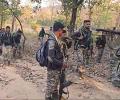
Chhattisgarh Deputy Chief Minister Vijay Sharma has reiterated the state government's willingness to engage in unconditional peace talks with Naxalites, following a statement by the Maoist group outlining preconditions for a ceasefire. Sharma, who holds the home portfolio, stated that the government has already made its stance on unconditional talks clear and has implemented a surrender and rehabilitation policy for Naxal cadres. He criticized the Maoists' demands as unreasonable and emphasized the importance of ending violence and joining the national mainstream. Sharma also called on the Naxalites to send a representative if they are serious about peace talks, but ruled out the formation of a separate committee for negotiations. The Maoist statement, released in Telugu, highlighted the group's concerns regarding intensified counter-insurgency operations and alleged human rights violations. They appealed for a positive atmosphere for peace talks, calling for a halt to anti-Naxal operations and the establishment of new security camps.

The killing of Naxal leader Vikram Gowda by the Anti-Naxal Force (ANF) in Karnataka was a last-resort action during a "chance encounter," according to the state's Internal Security Division DGP Pronab Mohanty. He refuted claims of an ambush, stating that ANF personnel gave Gowda ample opportunity to surrender before firing. The encounter occurred during combing operations in the Udupi district. Gowda had multiple extortion and criminal cases registered against him. The ANF recovered a 9 mm calibre gun from his possession. Following the encounter, combing operations in the forest area have been intensified to apprehend other Naxal members. The DGP also highlighted Karnataka's special surrender policy introduced in 2024, offering a rehabilitation package for Naxalites willing to surrender. The ambulance carrying Gowda's mortal remains overturned near Hebri on Wednesday, but the journey continued after the vehicle was restored to its correct position. Gowda's last rites were conducted on Wednesday afternoon.

'The strategy of frontal organisations of the Maoists is to create unrest and ensure that such unrest leads to a law and order problem.' 'To cover such acts it was necessary to bring in a different definition of unlawful activities which is different from the definition of unlawful activities in the UAPA.'

The surrendered Naxal said such arguments and counter-arguments led to internal dispute. "I felt suffocated and a sense of remorse started setting in."
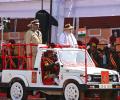
Union Home Minister Amit Shah has declared that Chhattisgarh will be free from the menace of Naxalism by March 31, 2026. He stated that the Centre and the state government are committed to eradicating Naxalism, highlighting the significant achievements of the Chhattisgarh police in the last year. Shah also appealed to Naxalites to surrender and join the mainstream, emphasizing the government's rehabilitation policy. He further praised the Chhattisgarh police's efforts in curbing organized crime and narcotics.
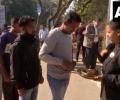
Former Maoist insurgents have revealed a shocking practice within the CPI (Maoist) organization, where cadres are forced to undergo vasectomy before they are allowed to marry. This policy, designed to prevent distractions and ensure loyalty to the movement, has been implemented across the organization. The practice has been highlighted by several former insurgents who have now surrendered to the authorities.
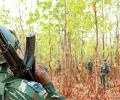
Earlier on Monday, two women Naxalites were killed and one CoBRA jawan was injured in an encounter during the same operation, they said.
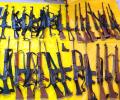
When the fierce encounter ended around 3:30 PM on Saturday after almost 10 hours, senior cadre Milind Teltumbade and 25 ultras had been killed.

The driver of a Scorpio that was right behind the vehicle targeted by Naxalites with an improvised explosive device (IED) in Chhattisgarh's Dantewada district on Wednesday said he won't be able to forget the day long as he lives.
They said the Maoist party in India failed to involve the masses and the leadership was not ready to adapt to changing times.
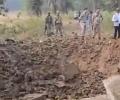
Eight District Reserve Guards (DRG) jawans and a civilian driver were killed in Chhattisgarh's Bijapur district when Naxals detonated an improvised explosive device targeting their vehicle. The incident occurred near Ambeli village while the security personnel were returning from an anti-Naxalite operation. This is the biggest Naxal attack on security forces in the region in the past two years.
